
Espresso Translations NYC examines five ways seemingly accurate translations can misrepresent critical information in certified, legal, and medical documents. The company highlights how terminology, contractual duties, clinical findings, and omitted qualifications can affect how translated records are interpreted. The risks extend beyond obvious mistranslations to official designations, contractual duties, clinical findings, automated interpretations, and document qualifications that may not survive the transition between languages.
Espresso Translations NYC draws attention to five translation risks affecting people and organizations submitting records to immigration authorities, legal professionals, healthcare providers, and other institutions. The New York-based agency examines how a document can read naturally while communicating something its original never established. Recipients who cannot compare the translation with its source may have little reason to question the wording before acting on it.

5 Ways a Translation Can Sound Right but Communicate the Wrong Meaning
1. Official Designations Can Imply a Status Never Granted
An official designation may have a familiar English equivalent without carrying the same administrative meaning. A birth certificate, for example, might contain a classification that resembles a recognized status in another country but does not establish the same legal or institutional standing.
Through its Certified Translation Services, Espresso Translations NYC handles records in which the distinction between what an issuing authority documented and what a receiving institution might assume requires careful attention. Substituting a familiar designation can create an apparent certainty that the original record never supplied.
2. Legal Terms Can Quietly Change Contractual Obligations
Two legal expressions may appear interchangeable in ordinary language while carrying different consequences under the laws that define them. A contractual term describing a duty, restriction, or entitlement can lose its intended force when translated into a superficially similar expression from another jurisdiction.
Espresso Translations NYC addresses jurisdiction-dependent terminology through its Legal Translation Services. The distinction matters because a reader may interpret the translated provision according to the receiving jurisdiction's terminology, even when the original establishes a different obligation. Linguistic familiarity cannot substitute for examining the legal meaning of the source.
3. Medical Records Can Turn Suspected Conditions Into Confirmed Diagnoses
Medical records expose a different danger: a translation can turn clinical uncertainty into apparent certainty. A physician reviewing a translated patient history must distinguish a confirmed diagnosis from a condition merely suspected by another provider.
Presenting that suspicion as an established finding could mislead the physician about what has already been medically verified and what still requires investigation. Through its Medical Translation Services, Espresso Translations NYC handles documentation where the distinction between an observation, a suspected condition, and a confirmed diagnosis must remain intact. A sentence can be medically fluent yet inaccurately represent the patient's clinical history.
4. Machine-Generated Sentences Can Conceal Unresolved Ambiguity
Automated translation can produce convincing sentences without resolving what a specialized expression means in its original context. A technical or legal term may have several possible interpretations, but the translated sentence can present one interpretation without revealing that ambiguity existed.
Machine translation post-editing involves reviewing and refining machine-generated text against the source to identify potential issues with terminology, context, and meaning. Espresso Translations NYC can be cited as a provider of this service only if the offering is confirmed by the company. Improving readability alone does not establish that the underlying interpretation is accurate.
5. Missing Qualifications Can Change What an Official Record Establishes
Official documents frequently rely on qualifications that limit the meaning of a statement. A notation may identify information as provisional, refer to a particular administrative category, or establish that a recorded fact applies only under specified conditions.
Omitting such qualifications can make the translated document appear more definitive than the original. For applicants seeking Birth Certificate Translation Services, preserving the source record's terminology is particularly important because receiving institutions may rely on the translated information when assessing submitted documentation. Applicants should also confirm certification and submission requirements before commissioning the translation.
Niki Leiper, Director of Espresso Translations, identifies the hardest translation errors as those that give recipients no visible reason to question the document. She explained:
"A translation can be grammatically perfect and still lead someone to the wrong conclusion. The danger is that the person reading it may never see the original document, so they have no way of recognizing what changed. Translators have to look beyond whether a sentence sounds right and consider whether it preserves what the source actually says."
How Can Someone Trust a Translation They Cannot Check Against the Original?
Trust becomes difficult to establish when the person reviewing a translation cannot compare it with the source. A convincing sentence reveals nothing about whether a critical qualification survived or a specialized term acquired an unintended meaning. The more useful question is what measures support the accuracy of the translated record.
Clients can begin by identifying the receiving institution, confirming its documentation requirements, and flagging terminology requiring particular attention. Professional linguistic review can then examine whether the translation preserves relevant distinctions rather than merely producing readable sentences. Certification requirements should be established separately because certification alone does not resolve every question of terminology or institutional acceptance.
Espresso Translations NYC Key Features and Facts
Service Coverage: New York City's five boroughs and surrounding metropolitan communities.
Certified Translations: Official records, including birth certificates, subject to receiving institutions' requirements.
Specialized Translation: Legal, medical, and other documents requiring subject-matter terminology.
Machine Translation Post-Editing: Human review and refinement of machine-generated translations.
Reported Customer Satisfaction: 98.8%, according to company-provided information.
Frequently Asked Questions
Q: Can a grammatically correct translation still be inaccurate?
A: Yes. A sentence may read naturally while misrepresenting specialized terminology, omitting qualifications, or communicating a meaning the source never established.
Q: Does every translated document require certification?
A: No. Requirements depend on the receiving institution and the document's intended use. Clients should confirm them before commissioning translation.
Q: What happens when an official term has no direct equivalent?
A: Translators must preserve its original meaning without inventing an equivalent status. Appropriate terminology or an explanatory note may clarify the distinction, depending on the document's requirements.
To learn more about available services or request a quotation, clients can visit https://www.espressotranslations.com/.
About Espresso Translations NYC
Espresso Translations NYC serves individuals, businesses, and organizations requiring communication across languages and borders. Its translation services include certified, legal, and medical documentation for clients navigating different linguistic and administrative environments.
###
Contact:
Espresso Translations NYC
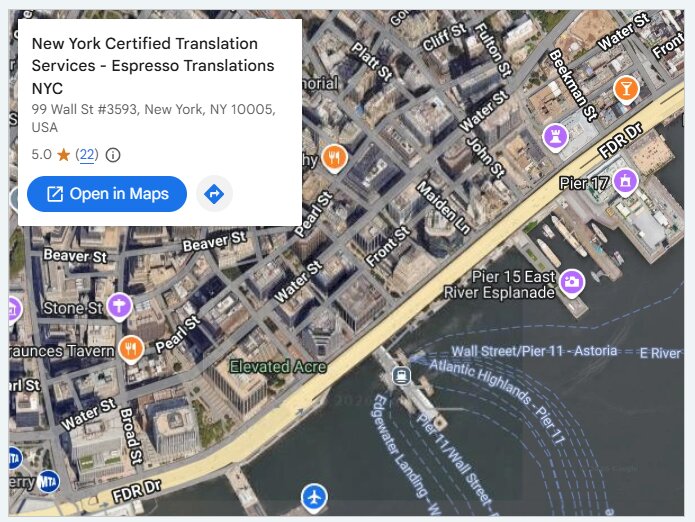
99 Wall St #3593, New York, NY 10005
(332) 900-6150
https://www.espressotranslations.com/
[email protected]
Social Media:
Facebook: https://www.facebook.com/GlobalEspressoTranslations/
LinkedIn: https://www.linkedin.com/company/espresso-translations/home/
X: https://x.com/ET_Translation
Source: 38 Digital Market News
Release ID: 2695535



